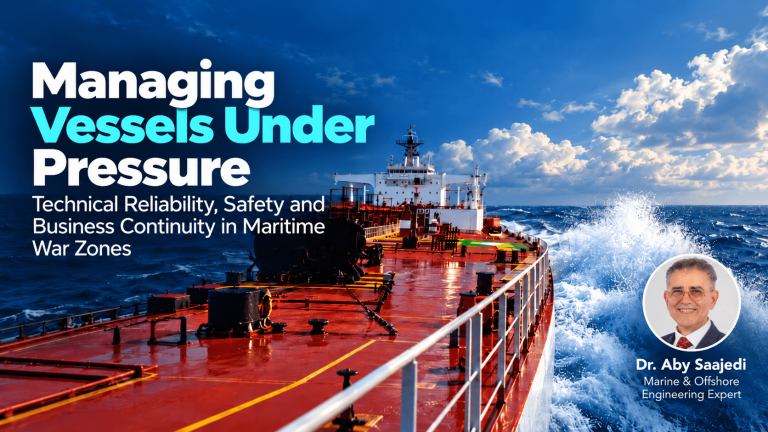
Managing Vessels Under Pressure: Safety in Maritime War Zones
Technical Reliability, Safety and Business Continuity in Maritime War Zones
- Overall assessment
The article presents a clear and valuable central message: crew safety must take precedence over commercial schedules, and operational continuity depends on preparation, communication, effective leadership and sound technical control. Its concise style is suitable for a general audience. However, if the intended focus is maritime operations in war zones, the article currently remains too general. It should define the threat environment more precisely and distinguish ordinary technical failures from damage or disruption caused by hostile action.
- Key improvements required
- Define the operating context. Clarify whether “under pressure”, “serious disruption” and “emergency” refer to general shipboard incidents or specifically to war-zone operations. If war zones are the focus, say so in the title or opening paragraph and identify the relevant threat categories.
- Use a complete safety framework. Address the three connected objectives of safety at sea: protection of life, prevention of pollution, and protection of the vessel and other assets. Environmental consequences should be included alongside crew safety and damage control.
- Differentiate technical failure from hostile damage. A machinery or control-system failure is not equivalent to a missile strike, drone attack, mine damage or forced boarding. Explain that the cause, extent, secondary effects and available response options differ. The article need not catalogue every weapon, but it should give a small, representative set of war-zone examples.
- Clarify owners’ and managers’ responsibilities. Distinguish the shipowner’s ultimate responsibilities from the duties delegated to an in-house or contracted ship-management company. Emphasise clear authority, escalation routes, timely decisions and continuous support to the vessel.
- Make preparedness practical. Retain the article’s emphasis on training, but connect it to realistic drills, contingency plans, communication failure, critical-system redundancy, spare-parts availability, damage assessment and defined decision thresholds for continuing, diverting or stopping a voyage.
- Include external response arrangements. Consider pre-arranged access to salvage, firefighting, emergency towing and other specialist support where feasible. The review notes historical use of support vessels accompanying tanker movements during the Iran–Iraq War; this is a potentially useful precedent, but any proposal for modern deployment requires independent assessment of feasibility, risk, cost and coordination.
- Support technical claims with references. Add a short, credible reference list for applicable maritime safety requirements, emergency preparedness and war-risk guidance. Historical examples and technical assertions should be sourced rather than presented as established facts without attribution.
- Technical scope: a proportionate treatment
The review identifies a useful system point: failure of a seemingly basic service can disable several dependent systems. For example, loss of control air may affect multiple pneumatic controls, depending on the vessel’s design and safeguards. The article should use this as a concise illustration of system dependency, not imply that every ship will experience the same outcome. It should also distinguish pre-existing defects and maintenance or supply-chain weaknesses from direct or indirect damage caused by hostile action.
For a war-zone-focused paper, the threat assessment should consider, at a high level, missile and rocket strikes, aerial or surface drones, mines and underwater threats, gunfire, hostile boarding, and possible sabotage. Each threat should be linked to its operational implications for people, propulsion, steering, electrical power, communications, firefighting, watertight integrity and pollution prevention. Detailed claims should be verified against authoritative sources and the vessel’s actual design and risk assessment.
- Recommended decision framework
The article would be stronger if it organised the response around four stages:
- Before transit: assess route-specific threats; verify critical systems and essential spares; brief and drill the crew; agree reporting channels, shore contacts and decision authority; identify available external assistance.
- Initial incident: protect life; raise the alarm; establish command and communications; assess immediate hazards and damage; control fire, flooding and pollution risks where safe to do so.
- Stabilisation: confirm the status of propulsion, steering, power, navigation and communications; determine whether the vessel can be safely controlled; request specialist support and report material changes in risk.
- Recovery or termination: decide whether to continue, divert, anchor, evacuate or suspend the voyage based on a documented risk assessment and competent authority—not commercial pressure alone.
- Suggested editorial direction
Preserve the article’s concise, people-first message, but avoid expanding it into an exhaustive list of weapons or technical failure modes. Instead, add a short war-zone definition, a representative threat-and-consequence paragraph, explicit pollution prevention, clearer owner/manager accountability, and a practical preparedness-to-recovery framework. This would improve precision without losing readability.
- Conclusion
The article is a sound introductory statement on safety-led operational resilience, but it is not yet a sufficiently specific treatment of ship management in maritime war zones. Its main revision priorities are to define the operating context, distinguish hostile damage from conventional technical failure, integrate environmental protection, clarify responsibilities, and turn its general advice into a staged decision framework. Any expanded technical or historical claims should be supported by reliable references. These changes would make the paper more precise, actionable and credible while retaining its succinct style.
Dr. Aby Saajedi
Marine & Offshore Engineering Expert
Linkedin