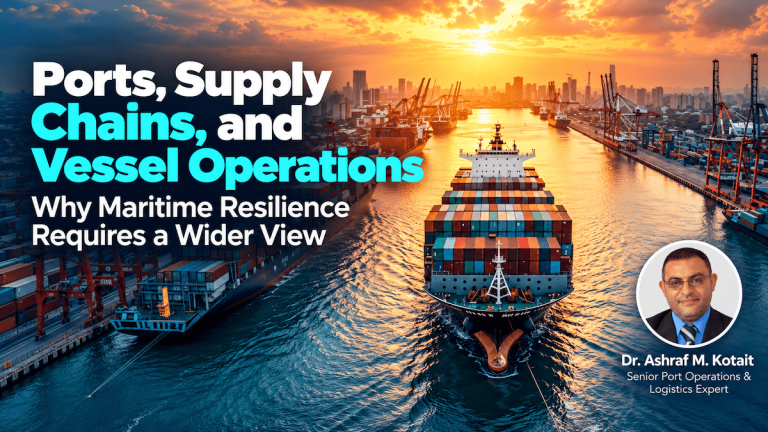
Ports, Supply Chains, and Vessel Operations: Why Maritime Resilience Requires a Wider View
When a vessel falls behind schedule, the problem rarely stays with the vessel.
A missed berth window can affect the next fixture. A longer voyage can increase machinery hours and maintenance exposure. A rerouting decision may introduce additional security or insurance risk. Delays can create additional bunker costs, commercial consequences, and disruption further along the logistics chain.
What initially appears to be a vessel operations problem can quickly become a business, port, and supply chain problem. That is why maritime resilience requires a wider view.
“When a voyage goes off plan, the question is not only whether to reroute or wait. Time, cost, risk, and vessel capability all have to be considered.” — Dr. Ashraf M. Kotait
Consider a few realistic situations:
- A vessel arrives late and loses its planned berth window.
- A three-day delay begins to affect the next fixture or charter schedule.
- Rerouting reduces one operational problem but introduces higher security, insurance, or war-risk exposure.
- Extending the voyage means additional machinery hours and greater technical exposure.
- Operations understands the schedule, finance understands the cost, commercial understands the contract, and the technical team understands the vessel, but nobody sees the complete picture quickly enough.
The disruption may begin in one place. Its consequences do not.
The Vessel Is Part of a Wider Operational Chain
When something goes wrong during a voyage, the instinct is often to treat it primarily as an operational question: Should the vessel continue or wait? Should it reroute, or should the operation be suspended?”
But these decisions cannot be evaluated from an operational perspective alone.
Time matters, because being late can affect berth windows, fixtures, contractual commitments, and subsequent operations.
Cost matters, because disruption continues accumulating through fuel consumption, additional operating days, demurrage, and other consequences. For ship owners, tracking the cost of delay as a rate — per hour or per day — rather than only as a final expense can make the financial impact of waiting or rerouting clearer while decisions are still being made.
Risk matters, because an alternative route may expose the vessel and company to different security, regulatory, or insurance conditions.
Vessel capability matters, because a technically possible route on paper still needs to be safely executed by the vessel itself.
Ports, vessels, commercial commitments, and logistics schedules are therefore not separate problems. They are connected parts of the same operating environment. A decision that appears correct for one department can create a larger problem somewhere else.
From Fragmented Decisions to Maritime Resilience
One of the greatest challenges during disruption is that different teams often hold different parts of the truth. Operations knows the schedule, while the commercial team understands the contractual implications. Technical teams assess vessel capability, and finance evaluates the accumulating costs.
The problem appears when these perspectives are reconciled too slowly.
There are two common weaknesses: an escalation gap, where the people closest to the problem cannot make the required decision, and a reconciliation gap, where different departments have information but nobody brings it together quickly enough.
For ship owners, managers, and port stakeholders, resilience increasingly depends on being able to activate predefined plans.
They do not need to predict every disruption. Instead, they should establish who joins the decision, what information is required, and how quickly a decision must be made.
This wider operational perspective also highlights the importance of connecting vessel operations with technical, maintenance, procurement, and management information. The objective is not simply to optimize an individual vessel or department, but to understand how decisions in one area affect the wider operation.
Maritime resilience comes from understanding how the pieces affect one another and making the right decision while there are still options available. The disruption may start with the vessel. Resilience depends on seeing everything around it.
Dr. Ashraf M. Kotait
Senior Port Operations & Logistics Expert | Transport Sector Consultant
This article features insights from Dr. Ashraf M. Kotait, a guest speaker at SeaMaster’s maritime resilience webinar
Linkedin