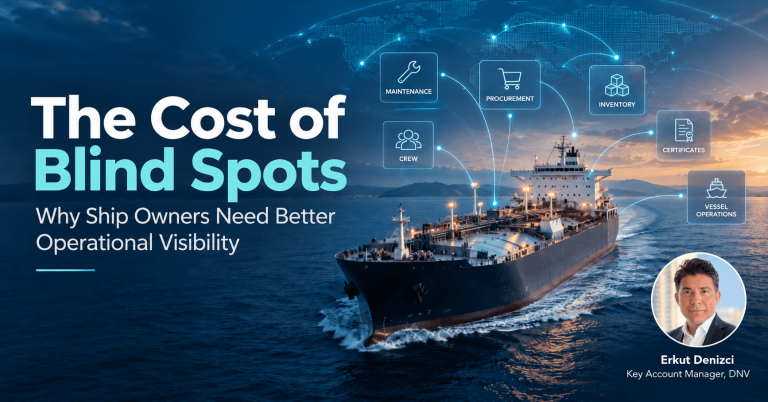
The Cost of Blind Spots: Why Ship Owners Need Better Operational Visibility
Ship owners do not usually lose control because they lack information. More often, the problem is that the right information does not reach the right person at the right time.
Every vessel generates a constant flow of operational data: maintenance records, spare-part requests, procurement activities, crew documentation, certificates, inventory movements, inspections, and daily operational reports.
The challenge is that this information is often spread across spreadsheets, emails, paper records, disconnected software, and different departments.
The result is not a lack of data. It is a lack of operational visibility.
For ship owners and managers, that blind spot matters. When shore teams cannot quickly understand what is happening onboard, small issues can develop into delays, unnecessary costs, compliance concerns, or operational disruption.
At SeaMaster, we believe effective ship management begins with connecting this information and turning it into something management can actually use.
Maintenance History Should Support Better Decisions
A Planned Maintenance System (PMS) should do more than remind the crew that a maintenance task is due.
Maintenance history provides valuable context about the condition and reliability of vessel equipment.
Technical superintendents and fleet managers need to understand questions such as:
Is a job overdue? Has this equipment failed before? What corrective actions were taken? Which spare parts were consumed? Is the same defect appearing repeatedly?
Looking at only the latest maintenance record may hide a much larger problem.
A recurring equipment issue can appear to be an isolated technical failure when information is fragmented. When maintenance history is connected and accessible, patterns become easier to identify.
This gives management an opportunity to act earlier—before a recurring issue becomes an emergency repair, operational delay, or potential off-hire event.
SeaMaster’s PMS and maintenance management approach is designed to keep vessel maintenance records structured, traceable, and accessible to both vessel and shore-based teams.
Certificate Management Is About More Than Expiry Dates
Certificates may be stored onboard, but simply having the document does not mean the organization has full visibility over its status.
Ship owners and managers need to know which certificates are approaching expiry, what renewal actions are required, which inspections are pending, and who is responsible for the next step.
When this information is maintained through individual spreadsheets, folders, or email reminders, compliance can become dependent on individual memory.
That creates unnecessary risk.
A structured certificate management system gives teams earlier visibility, allowing renewals and inspections to be managed before they become urgent.
The goal should not be to react to an approaching deadline. It should be to see it early enough that it never becomes a crisis.
Procurement Needs Visibility From Request to Delivery
Procurement is another area where operational blind spots quickly appear.
A vessel raises a requisition. The office reviews it. Suppliers are contacted. Quotations are received. Approvals are obtained. The purchase order is issued. Goods are delivered onboard.
At any point in that process, management should be able to answer one simple question:
Where is the request now?
The answer should not require searching through multiple email chains or contacting several people.
With SeaMaster’s procurement management workflow, vessel requests can move through defined stages from inquiry and quotation to order and delivery, giving teams clearer visibility over their status.
This becomes especially important when procurement is linked to maintenance.
An overdue maintenance job may not be caused by poor vessel planning. The real cause may be a spare part waiting for approval, quotation, purchase, or delivery.
When maintenance and procurement operate as disconnected processes, this relationship can easily be missed.
When information is connected, management can understand the cause of the delay—not just the symptom.
Crew Information Is Operational Information
Crew management should not operate independently from the rest of fleet operations.
Contracts, certificates, qualifications, attendance, appraisals, rest hours, and crew changes can all affect vessel readiness.
Consider a vessel approaching a technically demanding operation while several experienced crew members are due to sign off.
Each situation may look manageable when viewed separately.
Together, they may create operational pressure.
Better crew management visibility gives fleet managers the context they need to identify these situations earlier and prepare accordingly.
From Data Collection to Fleet Intelligence
Digitalization should not simply result in shipping companies collecting more data.
Most organizations already have plenty.
The real challenge is turning that information into fleet intelligence.
Maintenance, procurement, inventory, crew, certificates, and vessel operations should not exist as independent information islands. They influence one another every day.
SeaMaster is built around this principle: bringing key ship management processes into a connected environment so vessel and shore teams can work from a clearer operational picture.
For owners, technical directors, fleet managers, and superintendents, the value of an integrated fleet management platform is not simply having another dashboard.
It is reducing the time between an issue beginning and the right person understanding what is happening.
That time can make a significant difference.
Better Visibility Means Better Control
Shipping will always involve uncertainty. Equipment fails. Weather changes. Ports become congested. Crew situations change. Suppliers experience delays. Commercial priorities shift.
Technology cannot remove those realities.
What it can do is help organizations identify changes earlier, understand their impact faster, and coordinate the response more effectively.
That is the purpose of operational visibility.
For SeaMaster, digital ship management is not about creating more reports or more data. It is about connecting the information that already exists across the vessel and the office so decision-makers can see what matters and act earlier.
Because in modern ship management, one of the greatest operational risks is not simply that something goes wrong.
It is discovering it too late.
Erkut Denizci
Key Account Manager, DNV
Linkedin