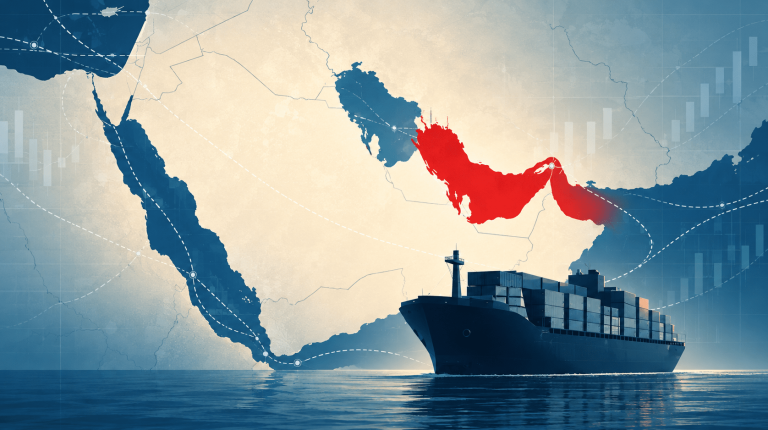
The $100,000 Captain: What the Strait of Hormuz Reveals About the Human Cost of Shipping Risk
Would you risk your life at sea for $100,000 a month?
For some tanker captains navigating the Strait of Hormuz, that is reportedly the level of compensation now being offered.
According to the Financial Times, some captains are receiving offers of up to $100,000 per month, with additional bonuses reportedly reaching $50,000 per transit.
These are exceptional reported arrangements, not standard maritime salaries.
But the number itself raises a much more uncomfortable question:
When shipping companies are willing to pay extraordinary amounts to keep vessels moving, what does that tell us about the risks their crews are being asked to accept?
And more importantly, who should ultimately decide whether those risks are acceptable?
A $100,000 Salary Is Not the Whole Story
At first glance, the headline sounds like an extraordinary financial opportunity.
For a seafarer, that amount could represent years of savings. For an experienced captain, it could appear to be compensation that reflects the seriousness of the assignment.
But there is another side to this story.
On October 11, ABC News Australia reported that shipping companies were offering significant hazard-pay incentives to attract crews willing to operate in the region.
Some advertisements offered double or triple wages. Maritime-union representatives also raised concerns about seafarers reportedly facing pressure to accept dangerous assignments.
This changes the nature of the discussion.
There is a fundamental difference between rewarding someone for accepting risk and making them feel they have no realistic choice but to accept it.
A high salary may compensate for difficult working conditions. It cannot, by itself, guarantee safety, informed consent, or adequate operational preparation.
The Numbers Behind the Risk
The Strait of Hormuz is not simply a difficult navigation area. It has become a place where geopolitical uncertainty directly affects the people operating commercial vessels.
According to the International Maritime Organization, as of October 9, 2026:
- 100 confirmed maritime incidents had been recorded across the Strait of Hormuz and the wider Middle East.
- 24 seafarer fatalities had been confirmed.
Reuters also reported that only seven commodity vessels transited the Strait on October 6, the lowest figure in more than two months, according to Kpler data.
These figures tell two different but connected stories.
One is about disruption to global maritime trade.
The other is about the human consequences of keeping that trade moving.
And while cargo movements can be rerouted, schedules revised, and commercial losses calculated, the consequences of a serious incident involving crew members cannot be treated as another operational expense.
A delayed cargo can be delivered later. A lost life cannot be recovered.
When Does Danger Pay Become a Warning Signal?
The maritime industry has always recognized that some voyages involve higher risks than others.
Hazard pay is not new, and additional compensation for dangerous assignments is not inherently unreasonable.
In fact, in March 2026, the International Transport Workers’ Federation and the Joint Negotiating Group designated the Strait of Hormuz, Persian Gulf, and Gulf of Oman as a Warlike Operations Area.
Under applicable International Bargaining Forum agreements, the protections include additional wage compensation, enhanced death and disability benefits, and defined rights to refuse entry and request repatriation.
These contractual protections are distinct from the exceptional commercial salary offers now making headlines.
But the reported $100,000 figure raises a broader question.
If the financial incentive must increase dramatically to convince qualified professionals to undertake a voyage, shouldn’t the industry also be questioning the conditions that make such incentives necessary?
There is no simple answer.
Owners face contractual commitments, energy supply obligations, insurance costs, charter requirements, and serious commercial consequences when vessels stop trading.
Captains and crews face a different calculation.
Their exposure is personal.
Both realities matter, but they are not interchangeable.
What Would You Do If You Were the Shipowner?
Imagine being responsible for a tanker scheduled to pass through the Strait of Hormuz.
The cargo is ready.
The charter commitment is active.
The commercial opportunity is significant.
The vessel is technically ready to sail.
But intelligence reports indicate an elevated security threat, and some crew members are uncomfortable proceeding.
What happens next?
Does the commercial department make the decision based on contractual exposure?
Does the technical department focus on vessel readiness?
Does the operations team assess the route and schedule?
Does the captain carry the final burden?
Or does senior management take responsibility for weighing all these factors together?
This is where an essential aspect of ship management becomes clear:
A vessel can be technically seaworthy and still face conditions in which proceeding is the wrong decision.
That distinction matters.
The question is no longer simply whether a ship can complete the voyage.
It is whether the voyage should proceed under the prevailing circumstances.
The Real Value of Operational Visibility
When conditions change rapidly, fragmented information becomes a serious management problem.
The technical team understands the condition of the vessel.
Operations monitors voyage developments and port conditions.
Commercial departments understand contractual exposure.
Crew management knows the availability, experience, and concerns of the people onboard.
The Master understands the vessel’s immediate operational reality.
But an owner needs to see how those different realities fit together.
This is where better information, clear escalation procedures, and well-defined decision responsibilities become essential.
Technology cannot eliminate the threat of an attack.
No dashboard can guarantee a safe passage through a conflict zone.
But effective ship management should help decision-makers recognize emerging risks earlier, evaluate alternatives, communicate with crews, and make decisions before commercial pressure leaves them with fewer options.
The objective is not simply to keep the vessel moving. It is to understand when moving remains the responsible choice.
The Question Behind the $100,000 Headline
The reported salary may eventually return to normal levels.
Shipping routes may recover.
Security conditions may improve.
But the underlying question will remain relevant long after this particular crisis.
How should the maritime industry balance commercial necessity with its responsibility to the people who make global trade possible?
Should exceptional compensation be viewed as an appropriate recognition of exceptional risk?
Or does the need to offer such amounts indicate that some voyages are approaching a level of danger that money should no longer be expected to overcome?
Perhaps the most important lesson from the Strait of Hormuz is that the true measure of responsible ship management is not how much an owner is willing to pay for a dangerous voyage, but how carefully the decision to undertake that voyage is made.
Because the people onboard are not simply another operating cost.
They are the people whose lives depend on those decisions.
Your Perspective Matters
For shipowners, captains, fleet managers, and maritime professionals:
If you were responsible for approving a tanker transit through a high-risk area, what would make you say NO — even if the commercial rewards were substantial?
Would it be the security intelligence, the crew’s willingness, the availability of safer alternatives, or something else?
I’d be interested to hear how professionals on both sides of the ship–shore relationship approach this decision.
Sources and further reading
- Financial Times — Ships’ captains paid $100,000 a month to transit Strait of Hormuz
- ABC News Australia — Shipping companies offering captains $US100k a month
- Reuters — Hormuz transits at lowest in over two months after attacks
- International Maritime Organization — Confirmed incidents in the Middle East
- ITF — Warlike Operations Area designation
- Lloyd’s List — Hormuz tanker attacks hit seven-month high